天猫
Takaichi avoids clear commitment to non-nuclear principles again at Nagasaki memorial_我的网站

一 |
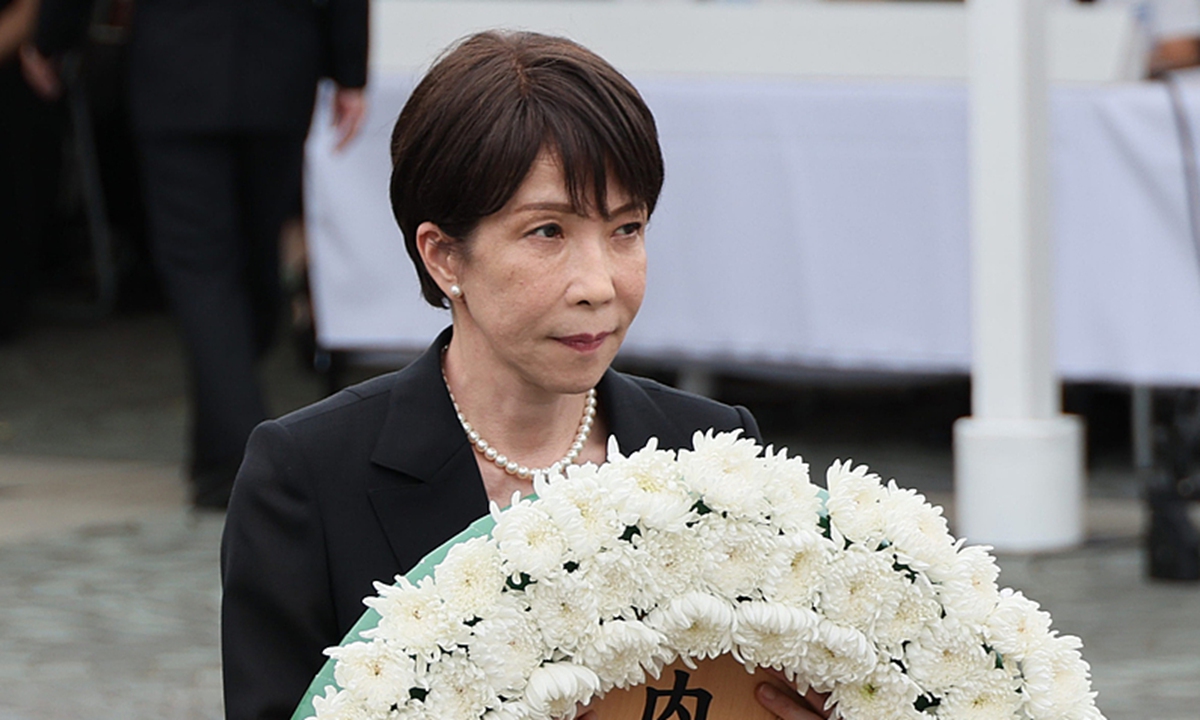
Japanese Prime Minister Sanae Takaichi attends a Nagasaki Peace Ceremony to commemorate the 81st anniversary of the atomic bombing at the Peace Park in Nagasaki City on August 9, 2026. Photo: VCGJapanese officials and members of the public urged the government to uphold the Three Non-Nuclear principles and pursue a security policy that does not rely on nuclear weapons, as Prime Minister Sanae Takaichi maintained an ambiguous stance on the long-held policy during a speech on Sunday marking the 81st anniversary of the US atomic bombing of Nagasaki.
Chinese experts noted that, similar to her ambiguous remarks at the memorial ceremony in Hiroshima, Takaichi stopped short of making a clear commitment to maintaining the Three Non-Nuclear Principles in the future, as her government's stance on nuclear issues has sparked concern and anger among the Japanese public. They also warned that, given Japan's lack of thorough reflection on its wartime aggression, Tokyo's moves to dilute the Three Non-Nuclear Principles should raise alarm across the international community.
"Our country firmly upholds the three non-nuclear principles, and under the pledge that 'Nagasaki shall be the last city to suffer a nuclear attack,' we are promoting realistic and practical initiatives toward the realization of a world without nuclear weapons," Takaichi claimed, according to the Japan Times.
But unlike previous prime ministers, many of whom had pledged that Japan would "continue to uphold" the principles, Takaichi merely described the government's current position without making an explicit commitment about the future, per the report.
As Hiroshima observed the 81st anniversary of the US atomic bombing of the city on Thursday, Takaichi also emphasized that Japan pledges to achieve a world free of nuclear weapons while upholding the Three Non-Nuclear Principles, despite Japanese media noting that she has left the door open for future revisions.
Takaichi's remarks in Hiroshima and Nagasaki that Japan upholds the three non-nuclear principles were largely seen as a reaffirmation of the country's existing policy position rather than a pledge to maintain the principles in the future, Liu Jiangyong, a professor at the Institute of International Studies at Tsinghua University, told the Global Times.
Liu said that currently, some Japanese officials' dangerous remarks on nuclear have sparked criticism among Japanese society. He pointed out that Takaichi only referred to Japan's current adherence to the principles, without explicitly committing to preserving them going forward. Her subsequent focus on broader goals such as achieving a "world without nuclear weapons" has further fueled questions over her actual policy intentions.
Japanese Defense Minister Shinjiro Koizumi claimed in an online program released in July that discussions on nuclear weapons were necessary to strengthen Japan's defense capabilities, according to Kyodo News. While acknowledging that the issue was difficult to discuss in Japan, he claimed it was something that "could not be avoided."
Opposition to the Takaichi administration's nuclear-related moves has emerged across Japan, including from local governments, media organizations and civil society groups.
According to statistics from the Japanese Diet, at least 128 local assemblies across the country had submitted written opinions to the central government or parliament between Takaichi's inauguration on October 21 last year and July 28 this year, calling for the country's Three Non-Nuclear Principles to be upheld, according to Xinhua News Agency.
In an interview with the AFP, 82-year-old Satoshi Tanaka, a campaigner who survived the 1945 attack on Hiroshima expressed frustration that current political leaders like Takaichi are focusing on military capacity at the expense of diplomacy.
"There is so much talk about national security. What about building peace through diplomacy?" he said.
Responding to a question concerning the Japanese authorities are rebuilding Japan's war machine, seeking to revise the Three Non-Nuclear Principles, and pursuing nuclear sharing with the US, even the possession of nuclear weapons, Chinese Foreign Ministry spokesperson Lin Jian said on Thursday that the devastation and tragedies brought by nuclear weapons should never repeat themselves. That said, the particular context of the nuclear explosions should all the more be remembered and the lessons of Japanese militarism's aggression and expansion must forever serve as an alarm.
The Tokyo's moves on nuclear policy have also raised concerns in the international community.
Russia considers the rhetoric of Japanese authorities regarding the need for Japan to revise its Three Non-Nuclear Principles provocative and unacceptable, Russian Ambassador to Japan Nikolai Nozdrev said in an interview with RIA Novosti, which was published on Saturday.
Responding to Koizumi's remarks on nuclear discussion, Nozdrev said "This is the first time in Japan's history, as the only country to have suffered atomic bombings in Hiroshima and Nagasaki, that a sitting defense minister has publicly called for lifting the 'taboo' on discussions related to nuclear weapons. We consider such rhetoric from official Tokyo provocative and absolutely unacceptable."
Japan has yet to fully reckon with its wartime aggression, thus any attempt by Tokyo to move toward acquiring nuclear weapons could pose serious risks to regional peace and global security, Lü Chao, an expert on the Korean Peninsula issue at the Liaoning Academy of Social Sciences, told the Global Times.
Such concerns have become more pronounced as Japan increasingly portrays China as a major security challenge while highlighting perceived threats from other countries, against such a backdrop, any further steps to dilute the three non-nuclear principles are likely to heighten concerns internationally, particularly among countries that suffered from Japanese aggression during World War II, said Lü.
。 Suzanne Somers, the actress best known for her roles in TV comedies including "Three's Company" and "Step by Step," has died, her longtime publicist announced Sunday. She was 76 years old.“Suzanne Somers passed away peacefully at home in the early morning hours of October 15th," R. Couri Hay said in a statement. "She survived an aggressive form of breast cancer for over 23 years. Suzanne was surrounded by her loving husband Alan, her son Bruce, and her immediate family. Her family was gathered to celebrate her 77th birthday on October 16th. Instead, they will celebrate her extraordinary life, and want to thank her millions of fans and followers who loved her dearly."A private family burial will take place this week, Hay said, and a memorial will be held next month.Born Suzanne Marie Mahoney on Oct. 16, 1946, in San Bruno, California, Somers got her acting start in the late '60s and early '70s with small roles and bit parts in films like the 1968 Steve McQueen action classic "Bullitt," and Clint Eastwood's "Magnum Force" in 1973. That same year, she also had a brief but memorable appearance in the George Lucas-directed "American Graffiti," credited as "Blonde in T-Bird" who silently mouths the words "I love you" to star Richard Dreyfuss before driving away.Somers also appeared throughout the 1970s on hit TV shows including "The Rockford Files," "One Day at a Time," "The Six Million Dollar Man," "The Love Boat" and "Starsky & Hutch." However, her big break came when she was cast as the ditzy Chrissy Snow on the ABC sitcom "Three's Company" opposite Joyce DeWitt and the late John Ritter. The series, based on the British sitcom "Man About the House," revolved around the antics of three single roommates – Somers' Chrissy, Ritter's Jack Tripper and DeWitt's Janet Wood – living together platonically."Three's Company" was a hit, running for eight seasons between 1977 and 1984 and spawning several spinoff series. It also made Somers a sex symbol and household name. Before the show's fifth season, Somers famously demanded a raise from $30,000 an episode to $150,000, equal to what male co-star John Ritter reportedly was making then. When producers refused, Somers claimed health issues and declined to appear in two show episodes. Despite her popularity, her role was drastically reduced for the remainder of the season and she was fired when the season ended in 1981. Somers sued the show's producers for $2 million in response but received only a small fraction of what she asked.Widely criticized in the popular press for her "Three's Company" demands, Somers found it difficult for several years to secure acting, other than an occasional TV movie. She also starred on the short-lived, critically drubbed syndicated sitcom "She's the Sheriff" from 1987 to 1989. Somers also headlined a series of one-woman shows on the Las Vegas strip in the 1980s, which she reprised in 2015.To further help make ends meet, in 1990, Somers became the commercial spokesperson for the Thighmaster, a piece of personal exercise equipment meant to be squeezed between one's thighs to develop leg and hip strength. While the ubiquitous infomercials, featuring Somers in heels and a leotard, were widely lampooned, the product was a success, selling millions of units and earning Somers induction into the Direct Marketing Response Alliance Hall of Fame. Under her own business shingle, Somers ultimately began selling her own successful lines of personal products, including skin care, makeup, hair care and health products.Ten years after she was fired from "Three's Company," Somers scored her next big television role, when she was cast on ABC's "Step by Step" alongside "Dallas" alum Patrick Duffy. Similar to the plot of "The Brady Bunch," the sitcom starred Somers and Duffy as Frank and Carol, two single parents who married and blended their families, which consisted of three children each. Somers remained on this show, which was part of ABC's TGIF lineup until it changed networks for its final season, for its entire seven-season run, which ended in 1998.Somers worked sporadically in television in the years after "Step by Step" ended, including brief forays into talk. She gave Broadway a shot in 2005 with her one-woman show "The Blonde in the Thunderbird"– a reference to her cameo in "American Graffiti" more than 30 years earlier – featuring a collection of stories about her life and Hollywood career, but it closed after less than a week of performances due to poor ticket sales and bad notices. She also competed on season 20 of "Dancing with the Stars" in 2015 alongside her professional partner, Tony Dovolani, placing ninth.Somers battled breast cancer multiple times throughout her life. She was first diagnosed with the disease in 2000 during a routine mammogram and subsequently underwent a lumpectomy and radiation therapy for treatment, as well as seeking out alternative therapies. The actress opened up about additional bouts with breast cancer in 2023, telling ABC's "Good Morning America," "every now and then it pops up again, and I continue to bat it down.""This is not new territory for me. I know how to put on my battle gear and I'm a fighter," she continued at the time, adding that her husband had "been by my side every step of the way."Somers wrote numerous books, including memoirs, ones focused on health and wellness, cookbooks and even a collection of poetry. Her most recent was "Two's Company: A Fifty-Year Romance with Lessons Learned in Love, Life & Business," published in 2017.Somers was married twice. Her first marriage, to Bruce Somers, produced her only child, Bruce Jr., and ended in divorce in 1968 after three years. She met her future husband, Alan Hamel, in 1969 when she was a prize model on "Anniversary Game," the short-lived game show he was hosting. The two married in 1977 and remained together until her death.。
Current article:http://u9y.feishuozhuangkeqi.cyou/news/20260826_1908720.html
Published on:18:46:32
